Choosing among China’s top private label body scrub manufacturers takes more than comparing prices. A reliable partner should explain its ingredients, production process, quality checks, and customization options clearly. This guide introduces practical points buyers can use when assessing suppliers, from sample development to finished packaging.
A Private label body scrub may use sugar, salt, or other exfoliating particles, combined with oils, fragrance, and a suitable base. Ask for a sample and check its texture, scent, spread, and rinse-off feel. Look closely at the jar, too. A loose lid or messy label can affect a customer’s first impression. Small details matter.
Request clear specifications, ingredient information, production timelines, and the documents relevant to your market. Ask how the manufacturer handles batch consistency and product stability; do not rely on broad promises alone. If possible, compare samples under everyday storage conditions. One sample is not proof of long-term performance. That is easy to overlook.
“Top” is not a universal ranking. The right manufacturer depends on your target customer, order volume, budget, and preferred formula. Some suppliers may offer extensive packaging choices but require larger minimum orders. Others may be flexible, yet slower to communicate. Be candid about your needs, and record what each supplier confirms in writing. A careful comparison can help you find a manufacturing partner that fits your brand, without assuming every polished catalog tells the whole story.
China’s private-label body-scrub manufacturing sits within a large, competitive cosmetics industry. The National Bureau of Statistics of China reported cosmetics retail sales of 414.2 billion yuan in 2023, up 5.1% year on year. This figure covers cosmetics broadly, not body scrubs alone, so it should not be treated as a scrub-market estimate. Still, it signals substantial domestic demand and a wide supplier base. Manufacturers commonly support product development, bulk production, filling, and packaging, while buyers specify texture, fragrance, exfoliant, and container requirements.
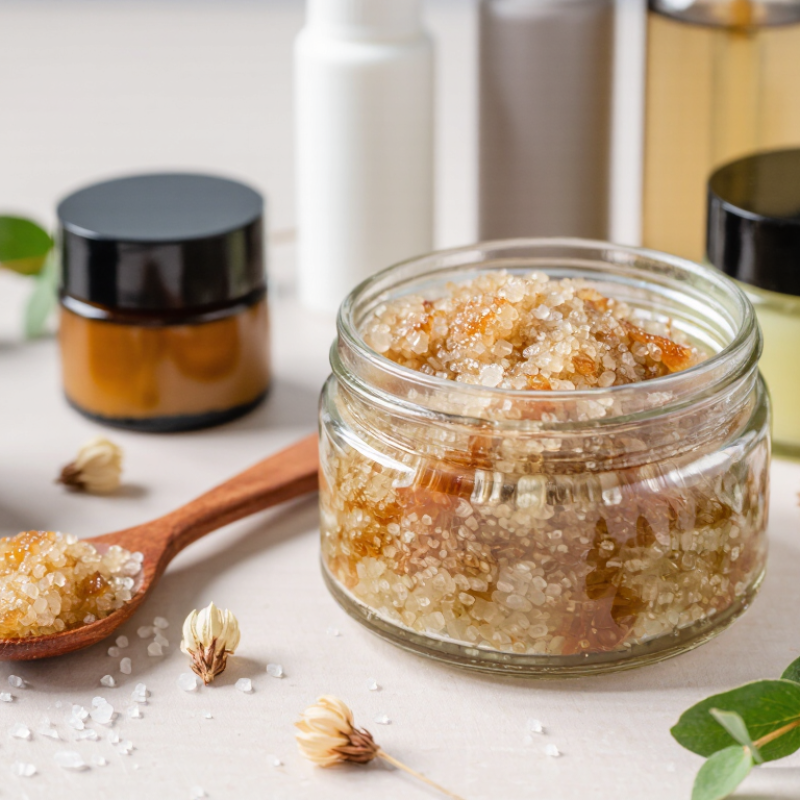
A scrub’s appearance can hide difficult production details. Sugar and salt crystals may dissolve or settle if the water phase and formula are poorly balanced. Particle size also affects how the product feels on damp skin and how easily it moves through a filling nozzle. Ask suppliers for sample batches, ingredient specifications, stability results, and batch-level quality records. Check how they handle temperature control and mixing, too. Small differences matter. A clear jar can reveal separation quickly, but appearance alone cannot confirm stability. I would treat supplier claims cautiously until samples are checked over time; that step is easy to underestimate.
Body scrubs generally fall into three formats: salt or sugar scrubs, finely milled plant-particle scrubs, and rinse-off formulas combining gentle exfoliants with moisturizers. Salt crystals feel crisp under wet fingers, while sugar dissolves more quickly during use. Particle shape and size matter; rough, oversized granules can feel harsh on delicate areas. Some formulas use lactic acid or fruit-derived acids instead of prominent grains. Not every skin type needs the same level of exfoliation.
Ingredient choices define both feel and performance. Glycerin and plant oils can reduce the dry, tight feeling after rinsing, while fragrance-free options suit shoppers seeking simpler formulas. In McKinsey’s 2024 State of Beauty report, the global beauty market is projected to reach $590 billion by 2030; this is a broad beauty-market estimate, not a body-scrub forecast. For private-label development, customization may include scrub particle, oil-to-grain ratio, scent, color, jar or tube, and rinse feel. Small differences show up fast.
A useful brief specifies the target user, shower habits, and preferred texture, then tests the formula on wet skin and in its final packaging. Check that particles suspend evenly and the product rinses cleanly. Fragrance can be lovely. It can also overwhelm. One common mistake is adding more exfoliant to make a scrub seem stronger; that may reduce comfort rather than improve the experience. Pilot batches and stability testing help catch separation, scent changes, or a texture that becomes unexpectedly runny.
A capable Chinese body scrub manufacturer should explain how it controls ingredients, production, and finished-product quality. Ask for documented procedures, not just a polished catalog. Check whether the facility can provide batch records, ingredient traceability, and recent quality-test reports. Specific answers matter.
Request samples made with the proposed formula and packaging. Examine the scrub’s texture, scent, and ease of rinsing. Note whether particles settle or the product separates after storage. Ask how the manufacturer assesses stability and microbial quality, and what conditions its tests cover. A sample can feel excellent on day one and behave differently weeks later. Test it yourself.
Factory visits, when practical, can reveal details that emails miss: clean filling areas, labeled material containers, and orderly storage. Ask about minimum order quantities, lead times, change controls, and how complaints are investigated. Compare answers across suppliers, and verify certificates with their issuing organizations when possible. A spreadsheet can still mislead. Price deserves attention, but unusually low quotes may leave testing or packaging assumptions unclear. No checklist catches everything. Keep written notes, request clarification, and be willing to revise your criteria when real samples challenge your first impression.
Suggested evaluation weights for comparing private-label manufacturing partners. These are a practical scoring framework, not market-survey results.
Prioritize product quality and regulatory compliance, then assess production reliability, formulation flexibility, packaging capability, and communication. Verify each area with documentation, samples, and a factory assessment.
A private label body scrub project depends on more than a good-looking sample. Manufacturers in China may offer mixing, filling, packaging, and formula adjustment under one production plan. Ask how they control particle size, viscosity, and settling. These details affect how a scrub feels in the hand and spreads on damp skin. Small batches matter. A pilot run can reveal problems that a lab sample misses, such as uneven fill levels or a cap that leaks during transport.
Quality control should follow documented checks at each stage. Incoming oils, exfoliating particles, and packaging components need clear specifications and traceable records. During production, teams can monitor batch temperature, mixing time, and fill weight. Finished goods should be checked for appearance, odor, seal integrity, and relevant microbiological limits. Keep retained samples from each batch. They help investigate changes over time, though they cannot prevent every issue.
Compliance work begins with the markets where the product will be sold. Request ingredient documentation, safety assessments where applicable, and accurate labeling support. Confirm who reviews claims and who approves the final artwork. A supplier may have strong equipment but limited experience with a specific destination market, so verify details rather than relying on broad assurances. There is no perfect process. Clear records, realistic timelines, and direct communication make gaps easier to catch before shipment.
When evaluating China-based private label body scrub manufacturers, request a written product specification before discussing price. It should identify the exfoliating material, particle size, fragrance level, and intended use. Ask for samples from the same production line planned for your order. A hand-filled sample may feel different from a factory batch. Check texture, rinse-off, scent, and consistency after storage. Small details matter.
Packaging choices affect both product performance and freight costs. Jars allow easy access but can admit water during shower use; tubes may reduce that risk, though thick scrubs can be harder to dispense. Test the formula with the actual container, closure, and inner seal. Look for leakage after transport simulation, not only on a clean showroom table. I have seen attractive packaging create avoidable rework when the opening was too narrow.
Before confirming an export order, align the ingredient list, label text, carton dimensions, and shipping marks with the destination market’s requirements. Request current product documents and clarify who prepares each export record. A customs broker can verify classification and documentation for the specific shipment. Build time for label review and pre-shipment inspection into the schedule. Delays happen. Even an experienced supplier may miss a small artwork change, so approve a dated final proof and retain it with the order records.
Ask for batch records, ingredient traceability, written quality procedures, and recent test reports. Specific records are more useful than a polished catalog.
Check its texture, scent, and rinse-off feel on damp skin. Watch for settling or separation after storage. Test it yourself.
A lab sample may not reveal uneven fill levels or leaking caps. A small production run can expose these issues before a larger order.
Ask how the facility controls particle size, viscosity, mixing time, and batch temperature. These details affect how the scrub spreads and feels.
Ask about appearance, odor, fill weight, seal integrity, and relevant microbiological checks. Retained batch samples can help investigate later changes.
Look for clean filling areas, labeled ingredient containers, and orderly storage. Emails can miss small details.
Confirm minimum order quantities, lead times, packaging assumptions, and change controls in writing. Compare answers across suppliers; a spreadsheet can still mislead.
Request ingredient documents, applicable safety assessments, and accurate labeling support. Confirm who reviews product claims and approves final artwork for the intended market.
Ask how complaints are recorded, investigated, and linked to batch records. Clear answers matter, though no checklist catches everything.
China’s private label body scrub industry offers a wide range of options for businesses seeking products tailored to different markets and customer preferences. Manufacturers may produce salt, sugar, and other exfoliating scrubs, with customization available for texture, fragrance, color, and ingredient combinations. Choosing the right supplier involves assessing product development support, communication, production experience, and the ability to meet requested specifications.
A reliable Private label body scrub manufacturing process also depends on consistent production controls, ingredient checks, and clear quality documentation. Buyers should discuss product samples, minimum order quantities, lead times, packaging formats, and labeling requirements before placing an order. Careful planning for packaging, transport, and export documentation can help ensure that finished products are suitable for their intended destination and arrive in good condition.