Formulation Engineering & Chemistry
Urea (carbamide) is renowned in dermatological science as one of the quintessential natural moisturizing factors (NMF). However, in cosmetic contract manufacturing, it represents one of the most chemically sensitive active ingredients. In an aqueous solution, urea is vulnerable to equilibrium hydrolysis, gradually degrading into toxicologically benign but organoleptically unacceptable ammonia and carbon dioxide.
This hydrolysis causes a sharp upward shift in bulk pH from a skin-neutral 5.0 up to alkaline values of 8.5 or higher. The consequences for brand owners are catastrophic: container bloating from gas formation, foul odors, loss of emulsion viscosity, microbial preservative deactivation, and intense epidermal stinging on compromised skin.
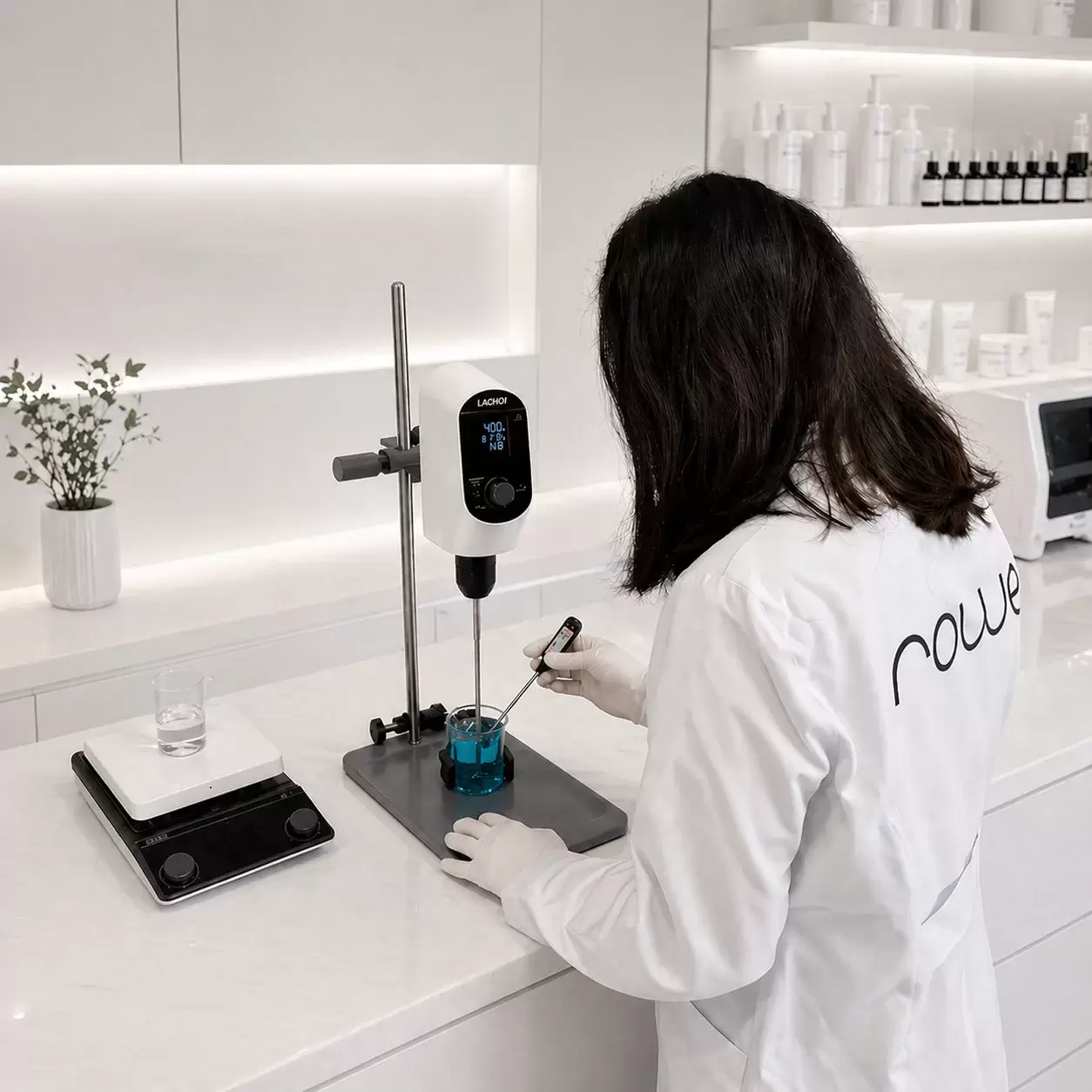
At Rowe Cosmetics, our in-house R&D chemists prevent these vulnerabilities at the molecular stage. We design a multi-tiered synergistic tri-buffer complex utilizing high-purity pharmaceutical synthetic urea, sodium lactate, and lactic acid. By stabilizing the aqueous equilibrium precisely between pH 5.2 and 5.8, our formulations preserve hydrolysis-resistance through rigorous accelerated stability testing protocols: 3 months at 45°C with 75% relative humidity and continuous freeze-thaw cycles (-10°C to +40°C).
Furthermore, our vacuum homogenizing vessels handle urea solubilization via a tightly temperature-monitored secondary phase injection below 40°C. This prevents thermal decomposition during high-shear emulsification, ensuring the final batch remains completely homogeneous, silky, and crystal-free throughout its multi-year retail shelf life.